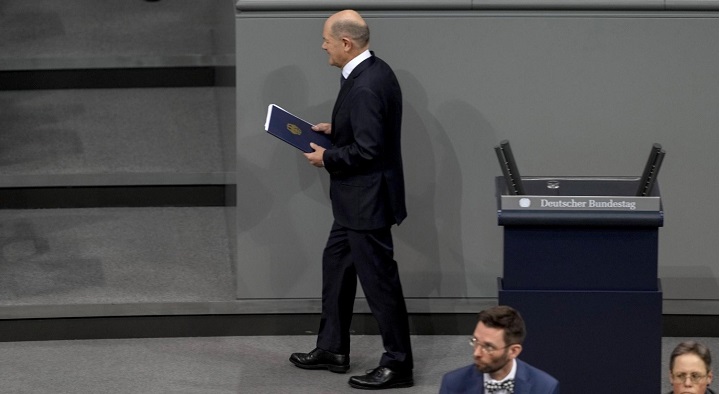
German Chancellor Olaf Scholz leaves after his speech during a plenary session at the German parliament Bundestag where he faces a vote of confidence, Berlin, Germany, Monday, Dec. 16, 2024. (AP Photo/Markus Schreiber) Associated Press/LaPresse.
This Monday, Germany’s chancellor Olaf Scholz of the social-democratic party (SPD) issued the Vertrauensfrage (eng. motion of confidence) in parliament. In the vote 394 members voted against him, 207 for him, and 116 abstained. As intended, the chancellor misses the necessary majority of 367 votes and thus loses the motion of confidence.
Scholz had submitted the motion last Wednesday and the open vote took place during yesterday’s parliament session, after a statement by Scholz and a debate among MPs.[1]
On November 6th the German government went into crisis after Chancellor Olaf Scholz (SPD) fired Finance minister Christian Lindner (FDP), the leader of one of three coalition parties (see here). This caused the coalition government to break apart. The coalition of SPD, the Greens party, and FDP had struggled with infighting and disagreements since its formation.
Chancellor Scholz promised new elections. To set this in motion, he needed to issue a motion of confidence.
Now that the parliament has officially expressed the loss of confidence in the chancellor, President Frank-Walter Steinmeier has 21 days to suspend parliament to make way for new elections. While it is possible for parliament to elect a new chancellor in their current constellation, all parties favour snap elections.
Four candidates for the position of chancellor have been brought forward. A short overview who the parties are sending into the election campaign:
- Christian Democratic Union and Christian Social Union (CDU/CSU): Friedrich Merz, leader of the CDU.
- Social Democratic Party (SPD): Olaf Scholz, current chancellor.
- The Greens: Robert Habeck, current Vice Chancellor and minister for economics and climate action.
- Alternative for Germany (AfD): Alice Weidel, co-leader of the AfD. [2]
The elections are supposed to take place February 23rd. Germany now enters a new election campaign period along with the holiday season.
[2] Mit diesen Kanzlerkandidaten gehen die Parteien in den Wahlkampf | tagesschau.de