Meaning is not a place where we arrive. Meaning is an orbit. It is a fall toward a centre that we never reach. If we take this image seriously, we see that there is more than one way to lose meaning. Byung-Chul Han sees only one: things drift away because nothing holds them any more.
Zygmunt Bauman shows that it matters who drifts, and why. And an old story from the road to Jericho shows a third way, the most uncomfortable one. A life can be held so firmly in its orbit that it passes by the wounded man. I want to follow these three steps.
At the end stands the question of what kind of centre could hold us without making us pass by. Pope Francis gives it a name: the heart.
The orbit
Isaac Newton described a simple thought experiment. A cannon stands on a high mountain. It fires a ball horizontally. The ball flies some distance and falls to the ground. The faster it flies, the further it goes. At a certain speed something strange happens. The ball keeps falling, but the earth curves away beneath it. It falls and falls and never hits the ground. It circles the earth. This is how every satellite works. An orbit is a fall that keeps missing its target.
Byung-Chul Han uses this image in his book The Scent of Time. He wants to explain why our present feels so empty of meaning. Many say that everything has become too fast. The French philosopher Jean Baudrillard put it dramatically. Modern life, he said, has reached “escape velocity”. Like a rocket leaving the earth, we have flown out of history and out of reality. Events now fly apart like particles in empty space.
Han disagrees. We are not too fast, he says. The earth has stopped pulling. The force that binds events together into a meaningful whole is fading. Han calls it the “gravity of meaning”. When it fades, things begin to float without direction. From the outside this looks like acceleration. In truth it is a loss of hold. And the same loss can also produce the opposite: standstill. When nothing selects what matters, everything piles up in the present. There are traffic jams of information. Haste and paralysis, for Han, are two sides of one coin.
He shows this with a novel by Michel Butor, L’emploi du temps. The narrator wants to write down what happened to him in a foreign city. He cannot. He cannot tell the important from the unimportant. He lingers over every detail, then rushes. In the end he cannot finish his story. It simply breaks off because his train is leaving. Han concludes: whoever cannot order their time cannot order themselves. Narrating means gathering events into a whole. Without this gathering there is no stable self. A crisis of time is a crisis of identity.
Two ways to fall out of orbit
Han thinks of the loss in one direction only. The pull weakens, and things fly off. That is why he longs for weight. At the beginning of his chapter he praises Heidegger. Heidegger wanted to bind human beings back to the earth, to home and soil. He spoke of Bodenständigkeit, of being rooted in the ground.
But an orbit is not ground. A satellite that reaches the ground is no longer a satellite. It has crashed.
So there is a second danger. Meaning can be lost by crashing. This loss does not look like a loss. It looks like firmness. A person has found their truth. They have a home, a creed, a certainty. They no longer need to search. They have arrived. In the image of the orbit, this means that their own movement has died out. The centre has pulled them in completely. Now they lie where they wanted to be. And they no longer move.
Here Baudrillard turns out to be right after all, though in a different way. Speed does matter. But not the speed of society. What matters is a relation. On one side there is our own momentum. On the other side is the pull of something greater than ourselves. Too little momentum, and we crash. Too much, and we are lost in empty space. Meaning exists only as long as the two hold each other in balance. We cannot possess it. We can only keep it moving.
The psychoanalyst Jacques Lacan described desire in a similar way. The drive never reaches its object. It circles around it. Whoever loves another person does not possess them. They circle around them. If the mystery of the other were fully solved, love would be over. Theology knows the same figure. The God of the Bible shows himself by withdrawing. Moses may see him only from behind. Whoever thinks they have God has an idol. Faith is not possession. It is an orientation. We fall toward something we never reach. Here missing is not failure. It is the very form of the relationship.
The pilgrim and his heirs
In the next chapter of his book, Han turns to Zygmunt Bauman. Having written my doctoral thesis on Bauman’s ethics, I read these pages with a certain sensitivity. I think Han gets Bauman wrong at the decisive point.
Han takes an image from Bauman. Modern man is a pilgrim. He crosses the world as if it were a desert. The desert has no form. The pilgrim gives it one. He sets himself a goal and walks toward it. Single steps become a path. Single days become a life. Bauman calls this “life as project”.
Han renders this correctly. Then comes the break. In postmodernity, Han says, the pilgrim has found successors. Bauman describes four of them: the stroller, the vagabond, the tourist, and the player. Han picks out two, the stroller and the vagabond. They buzz about instead of walking. They have no goal. They zap from image to image. Then comes his objection. The idea of freedom behind these figures, he says, is deeply problematic. Being free does not simply mean being unbound. Han turns to the history of words. The German frei is related to “love”, to “friend”, to “peace”. Whoever is free belongs to someone. Bonds make us free.
This is a beautiful thought. But it is not an argument against Bauman. It is Bauman.
Bauman does not describe his four figures because he admires them. He describes them because they all do the same thing. They keep the other at a distance. The stroller looks at people like goods in a shop window. The tourist visits places and moves on before they can ask anything of him. The player treats life as a game. If it goes badly, he starts a new one. None of these figures has to answer for anyone.
That is Bauman’s point. His ethics begins with a thought he takes from Emmanuel Levinas. I am responsible for the other before I have freely chosen anything. The face of the other makes a claim on me. I did not choose this claim. Only from this claim do I become who I am. The bond comes first. Freedom comes afterwards. Han attributes to Bauman an idea of freedom that Bauman spent half his life fighting. And he fights it with Bauman’s own weapons.
There is a second, heavier omission. By dropping two of the four figures, Han loses Bauman’s sharpest distinction. Tourists and vagabonds both move. But not for the same reason. The tourist travels because he wants to. The vagabond moves on because nobody lets him stay. For Bauman this is the core of the new inequality. Mobility has become the measure of rank. Those at the top can leave whenever they like. Those at the bottom must leave when they are sent away. Or they are not allowed to leave at all.
In Han this difference disappears. There is only “the human being” who drifts. A description of society becomes a description of being. This has consequences for Han’s own hope. At the end of his chapter he wishes that man might return to the earth as a walker. He should linger. But Bauman would have asked: whose earth is it? Those who are rooted in the ground today are often those who cannot leave. The worker in a town whose factory has closed. The old woman in a village everyone else has left. For them staying is not lingering. It is being stuck. Leisure, as Aristotle already knew, presupposes that others work.
In this, Han is not an exception. He is a symptom. Bauman is almost always quoted in shortened form. His word “liquid” has travelled everywhere. It appears in sociology, in journalism, in management books, in sermons. It has become a label for the present: everything flows, nothing lasts. But the label usually travels alone. Bauman’s ethics stays at home. Readers take the diagnosis and leave the moralist behind. They take the man who described the liquid world and forget the man who asked what we owe to the stranger in it.
This is a strange fate for a thinker. For Bauman never described the liquid world for its own sake. He described it because it makes it easier to look away. The liquid world, for him, is a world in which responsibility dissolves. Whoever quotes only the diagnosis turns a moral accusation into a neutral description of the times. And there is an irony in this. To read Bauman this way is to read him like a tourist. One visits his thought, takes a picture of the striking word, and moves on before it can ask anything of us.
What Bauman leaves open
So far the defence. Now I must grant Han something. His question touches a gap that really exists in Bauman.
Bauman has an ethics of the moment. The claim of the other strikes me now, without warning. But how do I live if I take this claim seriously? What does the time of a responsible life look like? For a long time Bauman barely answered. Only late, in his book The Art of Life (2008), did he ask this question. It appeared one year before Han’s book. Han probably did not know it.
Even there something remains open. Bauman speaks of character, which takes shape over the course of a life. But he keeps leaning on Levinas. And in Levinas there is no self that forms itself in peace. The other tears it out of its rest again and again. How can one gain a lasting disposition this way? Bauman leaves this tension standing.
There is a second gap. Bauman could lament the loss of solidarity. He could demand institutions, a welfare state that catches people when they fall. But he hardly showed how a single encounter with a face could become an order that carries many. He demanded. He grounded little.
These contradictions are not carelessness. They follow from Bauman’s starting point. If the moral impulse lies before all society, then nothing can produce it. No education, no institution, no practice. Everything that forms us is suspect. It is order, and order spreads responsibility so thin that in the end nobody is responsible. But as soon as Bauman asks how one should live, or what a society of solidarity might look like, he needs exactly this: formation. A character that grows. Institutions that hold. He has to contradict himself the moment he moves from the instant of encounter to duration.
The priest, the Levite, and the Samaritan
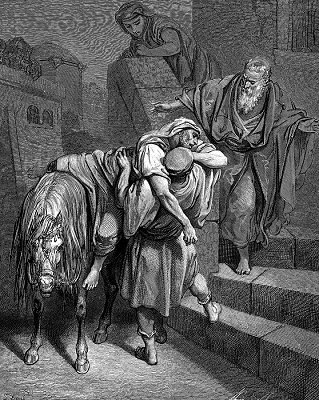
There is a figure missing from both Han and Bauman. It is older than the pilgrim, the tourist and the vagabond. A man lies wounded by the road from Jerusalem to Jericho. A priest comes by. He sees him and passes by on the other side. Then a Levite, a servant of the temple. He too passes by.
We must be clear about who is passing by. These are not drifters. They are people with education, with order, with a firm place in the world. Their lives have a rhythm of prayers, feasts and services. They have exactly what Han misses. Their time is structured. Their lives circle around a centre. And precisely this keeps them away. Whoever touches a dead body becomes impure under the law. Then he cannot perform his service in the temple. Their orbit is so firm that there is no room in it for the wounded man. This is the crash in a pious form.
Strangely, Han knows this himself. A few chapters later, discussing Jean-François Lyotard, he admits that every narrative is in a certain sense blind. It selects. It looks in one direction only. It always has a blind spot, and whatever does not fit its order disappears there. The wounded man lies in exactly this blind spot. Han does not draw the connection. He mourns the loss of narrative order in one chapter and notes its blindness in another, without letting the two meet.
Then comes a man from Samaria. For Jesus’s listeners he was a stranger, almost a heretic. He did not have the right education, the right temple, the right order. He stops.
In Fratelli tutti, Francis draws exactly this conclusion. The two who passed by were religious men. Faith and worship, he writes, are no guarantee that we live as God wants. And in Dilexit nos he warns against two temptations: believing that it is enough to know the Gospel, and believing that it is enough to carry out its demands mechanically.
Bauman reached the same insight through a much darker case. In Modernity and the Holocaust he asks who hid and rescued Jews during the war. He relies on Nechama Tec’s study of Polish rescuers. The result was disturbing. Education predicted nothing. Neither did class, nor piety, nor political conviction. Educated officials organised the deportations. Simple farmers hid children in their barns. And sometimes it was the other way round. For Bauman, morality is not a product of education. Society does not create the moral impulse. If anything, it silences it.
This strikes at the heart of Han’s hope. Han wishes for leisure, lingering, a time with weight. He believes that a gathered time will make a better person. The parable says something else. The priest and the Levite had a gathered time. The other one stopped.
The inn
But the Samaritan does more than stop. He does not stay alone with the wounded man. He takes him to an inn. He gives the innkeeper money and says: Take care of him. Whatever more you spend, I will repay you when I come back.
This sentence contains a whole order of time. The Samaritan makes a promise. A promise binds the future. It ties a thread between today and a day still to come. This is the threshold Han misses. Something gains weight. And it is more than a threshold. It is an orbit. It runs from the roadside to the inn and from there into time. And it connects people who did not know each other before: the stranger, the wounded man, the innkeeper.
Han himself is looking for such a time. Against Lyotard’s pure moment, which has neither memory nor expectation, he asks for a time of life that is neither a grand narrative nor a mere flash. He mentions Derrida in passing, who restores a kind of gravity from an open future, without returning to the old grand story. Han gives this two sentences and moves on. Yet this is exactly the structure of the Samaritan’s promise. It is no grand narrative. It is not a mere moment either. It is a small bond to a future that is still open.
Francis paid close attention to this. In Fratelli tutti he does not read the story as the heroic deed of one individual. The Samaritan looks for help. He makes his stopping a shared matter. Francis draws the conclusion that we should not expect everything from those who govern. We should seek others and form a “we”. The question “Who is my neighbour?” becomes the task of making ourselves neighbours. And doing it together.
This is the bridge that Bauman never built. The Samaritan shows, on a small scale, how a face becomes an institution. The inn is an institution in embryo.
And yet Bauman would have hesitated here. He distrusted the word “community”. For him it was a siren call. Community promises warmth and safety. In return it usually demands that we keep out those who do not belong. Bauman saw people fleeing into closed groups because the open world frightened them. Such communities ask little of each other and much of strangers: that they stay away.
The Samaritan’s community is built differently. It does not arise among equals but around a stranger. It was founded by someone who did not belong. Its centre is the one who lay on the ground. If we take this seriously, it is the opposite of what Bauman feared.
The heart
Francis gives this centre a name in his last encyclical, Dilexit nos. It is the heart. Two details in it are remarkable for our question.
The first: Francis begins his reflection with Bauman’s word. He speaks of “this ‘liquid’ world of ours” (DN 9). He is one of the few who take up the word without leaving Bauman’s question behind. For Francis, too, the liquid world is not just a description of our time. It is a world in which we lose the place where we can be reached by others. In such a world we must speak again of the heart. The heart is the place where each person creates a synthesis. Here the heart takes over exactly the task that Han missed in Butor’s narrator. It gathers the fragments. A later section of the encyclical even bears the title that the heart unites the fragments. Francis says that I am my heart (DN 14). It shapes my identity and at the same time puts me in communion with others.
The second detail is almost ironic. In the same chapter, Francis quotes Byung-Chul Han himself. He takes from Han’s reading of Heidegger the idea that thinking does not begin with a concept but with a shock, with deep emotion (DN 16). Han wrote his own doctoral thesis on Heidegger’s concept of mood, under the title Heidegger’s Heart. So the two meet at the heart. But they do not mean the same heart.
Han’s heart is attuned to the earth. It longs for soil, for lingering, for a time that rests in itself. Francis’s heart has a different centre. The heart he contemplates is a wounded heart. It was pierced by a lance. The centre of gravity is not the ground beneath our feet. It is a wound. In this sense the heart of Christ and the man by the roadside stand in the same place. Both are a centre that pulls us without letting us arrive. One does not settle down beside a wound. One stops, cares, promises, and goes on.
This heart also holds together what Han’s book keeps apart. It is shaken, as in the moment Lyotard describes. And it builds a history, as the narrative Han mourns. In the heart a moment becomes an orbit.
This also answers the question Bauman left open. A heart is more than a momentary impulse. In Dilexit nos it grows over time. It holds reason, will and feeling together and forms a stable identity. This is close to what Bauman meant by character, and closer to Aristotle than to Levinas. But how does such a heart grow if education does not produce morality? The Levite was educated. His education did not make him stop.
The theological tradition has a distinction for this that Bauman lacks. Thomas Aquinas speaks of acquired virtues, which we gain through practice. And he speaks of love, caritas, as a gift that cannot be acquired. It is given. But once received, it can grow. This would hold both sides together. The Samaritan did not learn his mercy the way the Levite learned his prayers. And yet it can become a heart that carries through time.
The open door
This answer has a price, and I do not want to hide it. A gift cannot be organised. It falls where it falls. In the parable it fell on the outsider, not on those who were trained for it. If love is a gift, then no institution can guarantee it. But Francis wants institutions. He speaks of political love, of a society that stops for the wounded. Can a society be built on something that cannot be produced?
The inn shows the danger. An inn quickly becomes a house with a door. And a door can be closed. The community around the stranger can turn into an order like that of the priest and the Levite. Then its orbit is firm again, and the next wounded man lies outside, in the blind spot.
Han seeks a time in which we linger. The Samaritan does not linger. He stops, creates a bond, and goes on, promising to return. Perhaps this is the orbit that Han misses: a path that circles around another without coming to rest beside them. A fall that keeps missing, and keeps coming back. Whether it can become a society, or only ever an inn, the parable does not say.